
Frequently Asked Questions |
Image

The territorial general election was held on November 3, 2025. With it, for the first time in over 100 years, Yukoners also voted in a territorial plebiscite on electoral reform.
The plebiscite vote was part of the territorial general election. Registration, voting times, places, and options for the plebiscite vote followed the territorial vote. The main difference an elector experienced is that they received two ballots.
You can find the Plebiscite vote official results on this page.
The information below is for reference use only, as the plebiscite vote has already occurred.
The Plebiscite Guide |
Elections Yukon has created a Plebiscite Guide to assist electors in learning about the plebiscite vote.
Image

The Plebiscite Vote |
When Yukon electors go to the polls, they will receive two ballots:
1. To vote for their Member of the Legislative Assembly (MLA) – vote for one candidate only; and
2. To vote on the plebiscite question about the voting system used by Yukoners to elect MLAs – vote YES or NO only.
The ballots will be of different colour and design, so they are easy to tell apart. The ballots will go into the same ballot box. At the close of polls, they will be counted separately.
Image
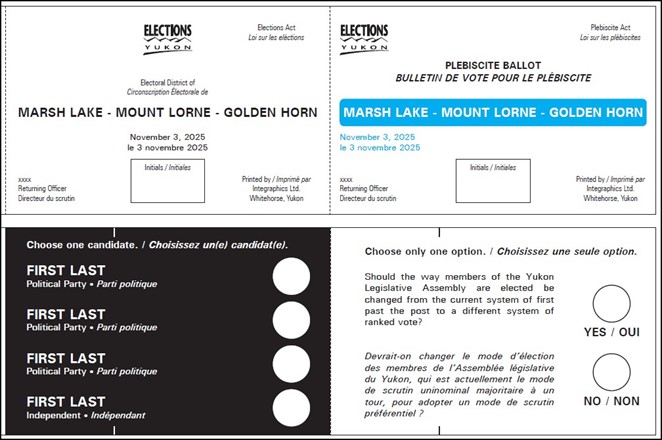
The Deputy Returning Officer at the poll will separate the ballot paper into two ballots. You will be provided two separate ballots.
The vote for the MLA in this election uses the first-past-the-post system. Mark only one candidate (this is not a ranked vote ballot).
When will the plebiscite vote be held? |
- The date the election will be called is not certain. Based on the fixed election date on November 3, 2025, the issue of the writ to start the election period would be no later than Friday, October 3, 2025.
- The election could be called earlier. A minimum of 31 days is required for the election period.
Voting in the plebiscite |
Who can vote?
You are eligible to vote if you are:
- 18 or older on polling day
- A Canadian citizen
- A Yukon resident for at least 12 months
- This is the same as the territorial election.
Can I vote if I’m going to be away?
- Yes. You can ask for a special ballot kit. Both ballots will be included.
- You can apply for a special ballot kit online or at any returning office.
- Special ballots can be completed by mail or in your district returning office.
- All electors have the option to vote by special ballot.
- Learn more about voting by special ballot.
Key terms made simple |
- Voting System: Voting systems, also called electoral systems, are methods of choosing political representatives. They are governed by a series of laws and administrative apparatus. First past the post and ranked ballot are types of voting systems.
- Plebiscite: A public vote to obtain the public opinion on a question being asked by the government.
- Majority: To win, a candidate requires the majority of votes, at least 50% plus 1 of the valid votes counted. In various documentation this is also referred to as an absolute majority.
- Plurality: To win, a candidate required a plurality, to have the most votes of all candidates. In various documentation this is also referred to having more votes than any other candidate.
- First Past the Post (FPTP): Each voter chooses one candidate and marks their ballot. The candidate with the most votes wins.
- Ranked Vote (RV): Voters rank candidates by preference (1, 2, 3, etc.). Counting happens in rounds. The candidate with the fewest votes is eliminated, and the votes are redistributed to next preferences until a candidate has a majority of at least 50% plus 1 of the votes counted.
- Eliminated candidate: If a majority is not reached, the candidate with the fewest votes is eliminated and the votes redistributed. This continues until a candidate reaches a majority.
- Redistributed votes: Votes of eliminated candidates are redistributed to the next preference of those voters in that round.
- Exhausted vote: A ballot that has no remaining preferences that can be redistributed to another candidate, or the voter did not rank additional preferences. That ballot is exhausted and no longer included in further counts. This will reduce the total of valid votes to be used in determining a majority.
The plebiscite |
- A plebiscite is a public vote on a question that’s important to the government.
- This plebiscite asks Yukoners if the way Members of the Legislative Assembly are elected should change.
- It is non-binding. This means the government does not have to make a change based on the results. The results will be important in guiding government decisions in the future.
- This plebiscite vote is part of the territorial election and will have the same voting processes, times, and options.
Background on the plebiscite |
- Between 2021 to 2023, special committees of the Legislative Assembly looked at voting systems and recommended a Citizen’s Assembly be established to consider if the current voting system should be changed. If so, what would be the recommended system should replace it. The Report of the Special Committee on Electoral Reform recommended in their 2023 Final Report that Yukoners be given the opportunity to vote on a proposed change to Yukon’s voting system both before any such change is implemented and again after a trial period with a new voting system.
- In 2024, a Citizens’ Assembly was created. The 38 members, representing all districts, recommended a ranked vote system. Read the report
- The government directed that a plebiscite vote be held with the next territorial general election for Yukoners to express their opinion.
- Elections Yukon was mandated to administer the vote and support the informed choice of Yukon voters.
The Plebiscite Threshold |
- The government set a threshold of over 50% of the valid votes cast in favour of a particular option to indicate an expression of public opinion.
The plebiscite question, systems and options |
The question
Should the way members of the Yukon Legislative Assembly are elected be changed from the current system of first past the post to a different system of ranked vote?
YES or NO
The two systems
- A first past the post is the current system used in the Yukon, where the winner is the candidate with the most votes (a plurality).
- A ranked votes is a system recommended by the Citizen’s Assembly where the winner must receive at least 50% plus 1 of the votes counted (a majority).
The vote options
- YES: Vote Yes to change to a ranked vote system. To win under this system, a candidate needs to receive a majority of votes counted (at least 50% plus 1).
- NO: Vote No to keep the current first past the post system. To win under this system, a candidate needs to receive the most votes.
Why Voting Systems Matter |
- Voting systems define how ballots are marked, how the count is conducted, and the vote requirements needed for a candidate to win. Different systems may produce different results in electing candidates and governments.
Common features of the two voting systems |
- Both systems would use the same electoral districts and boundaries.
- Both systems elect one Member of the Legislative Assembly to represent each district.
- Both systems tend to produce single party governments.
- Both systems are just as likely to form a majority or minority government.
- Neither system is a form of proportional representation.
Features of the two voting systems |
- How votes are counted are a defining difference between the two systems. First past the post systems elect based on one vote on a plurality requirement where the most votes win. Ranked vote systems elect on a preferential vote ranking requiring a majority where at least 50%of the votes counted are needed.
- The considerations of a voter in marking their ballots may be different between the two systems.
- A first past the post voter bases their choice of candidate on their one vote. A ranked vote voter bases their choice of candidate in order of preference, as many or as few as they wish. If there is no first preference majority, and their candidate is eliminated, their votes are distributed and counted for their next available preference.
| FIRST PAST THE POST | RANKED VOTE | |
| Key features |
|
|
| How votes are counted |
|
|
| Where used |
|
|
| Administration |
|
|
| To choose this option |
|
|
An example vote count of first past the post and ranked vote |
- Linked below is an example of a vote counting using the same results for first past the post results (final count) and a ranked vote (first preference votes).
- You can read more about how votes are counted in each voting system.
- For illustration, one possible scenario is used to follow the count process where additional rounds of redistribution and counting are required.
- The results in the ranked vote example are that the fictional candidate leading in the first round, but does not have a majority, is not the eventual winner. The additional rounds of counting would determine if there was majority support for that candidate.
- For Australia elections, which has been using a ranked vote system for over 100 years, about 11% of the first-round leader in the 2022 elections were not the eventual winners. Their result may not be representative of the Yukon context as a smaller jurisdiction with a different political landscape.
This fictional scenario compares the counting process between first past the post and a ranked vote. The example shows how different voting systems can change who is the winning candidate.
This example shows the counting process of a candidate leading in the first preference count without reaching a majority. Under a first past the post system, the candidate would be elected as having the most votes. With subsequent rounds in a ranked vote process, a different candidate is the eventual winner as having a majority of votes counted (at least 50% + 1).
Statement of the Vote (from all polls)
For a more detailed look at the counting of the votes, go here
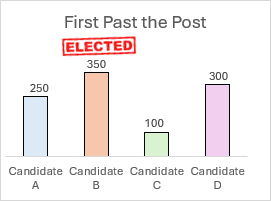
First past the post
- Single Tally of All Polls
Candidate |
FPTP Votes |
Image
|
Candidate A | 250 | |
| Candidate B | 350 | |
Candidate C | 100 | |
Candidate D | 300 | |
| Total Votes | 1000 |
Result: Candidate B is declared the winner as having the most votes. In this example the winning candidate received 350 votes of the total votes cast (35%). There were 650 votes for other candidates.
Ranked vote
If a majority is not reached on the count of first preference votes, additional rounds are only then required. Preferential vote redistribution to remaining candidates is for illustrative purposes for the ranked vote system.
- Initial Tally of all Polls and Redistribution of Votes
Image

| Candidate | Round 1 Votes | Round 2 Votes | Round 3 Votes | |
| With Redistribution | With Redistribution | With Redistribution | ||
Candidate A | 250 | 290 | Eliminated | |
Candidate B | 350 | 370 | 460 | |
Candidate C | 100 | Eliminated | Eliminated | |
Candidate D | 300 | 330 | 475 | Image

|
| Total Valid Votes | 1000 | 990 | 935 | |
| Majority/ Met? | 501/No | 496/No | 469/Yes | |
Result: Candidate D was elected with a majority vote (50.2%)
In this illustrative example, the second preferred candidate in Round 1 was the eventual winner in Round 3. Candidate D votes included first preference votes and redistribution of second and third preference votes of voters of eliminated Candidate C (after Round 1) and Candidate A (after Round 2).
The total votes, and majority of votes counted, are reduced by exhausted votes. These are the votes of voters whose candidate(s) were eliminated and did not have any next preference votes, or remaining candidates to redistribute their vote.
1. How will the voting process for the plebiscite work?
- The territorial election includes a plebiscite vote. The plebiscite uses the same voting times, polling places, and ways-to-vote options as for the territorial election. This includes voting by special ballots and at advance polls and polling day polls.
- The voting information will be provided in the various notices, voter information cards, websites, newspapers, and other advertisements.
- The key difference electors will experience this election is that when they go to the polls or vote by special ballot is that they will receive two ballots: one for their Member of the Legislative Assembly and one for the plebiscite vote. The ballots are different in design and colour, so they are easily distinguishable.
- Once the voter marks their ballots (one vote for MLA and one YES or NO vote for the plebiscite,) they will be placed in the ballot box. After the close of the polls, they will be counted and reported separately.
2. What is the difference between a plebiscite and a referendum?
- A plebiscite is used by the government to ask the public for its opinion on an important issue. The results may not be binding, meaning the government does not have to act on them. The results from this plebiscite are non-binding.
- A referendum is typically binding on government meaning the government needs to act on them.
3. What does “non-binding” mean for this plebiscite?
- The government does not have to make a change based on the plebiscite results. The results will still be important in guiding government decisions.
4. Do I have to vote for both the territorial election and the plebiscite?
When you go to vote you will receive two ballots and you will be marked off as voted. You can decline either or both ballots. Declined ballots are not put in the ballot box. The number of declined ballots is reported.
If you decline your ballot, you are considered to have voted. You cannot change your mind and vote again later.
5. What are there two ballots?
- One ballot is for the territorial general election to choose your Member of the Legislative Assembly. (Note – this is NOT a ranked ballot. Mark one choice.)
- The other ballot is to vote on the plebiscite question. You mark your vote as either YES or NO.
- The ballots will look different so they’re easy to tell apart.
6. What if I make a mistake on one of my ballots?
- Tell an election worker right away. You will return your ballot with the mistake. It will be marked ‘spoiled’ and put aside. It does not go into the ballot box. You will be given a new ballot.
7. What is first past the post?
- First past the post is also referred to as single member plurality or winner take all. Winner-take-all refers to electing one winner to represent the electoral district; the other votes don’t translate into proportional representation.
- Voters select one candidate only. The candidate with the most votes wins, whether or not they have a majority.
8. Where is first past the post used?
- Widely used system. Countries using the system include Canada, the United Kingdom, the United States, India, and most of the English-speaking Caribbean.
- It is the second most popular voting system. More countries use a form of proportional or mixed systems for voting.
9. What is a ranked vote system?
- Ranked vote is also referred to as ranked choice voting, alternate vote, preferential vote, and instant runoff voting. It is a form of winner-take-all as there is only one winner however, for ranked vote, a winner must have majority support.
- Voters rank candidates by preference (1st, 2nd, 3rd, etc.). To win, a candidate needs to have a majority of votes; at least 50% plus 1 of the votes counted.
10. Where are ranked votes used?
- Established system. Countries using the system include Australia, several US states, and Papua New Guinea. It is also used in various local, municipal, and political elections.
- Ranked vote is also used in multi-member/proportional systems in a number of countries.
11. How does counting and redistributing votes work in a ranked vote?
- Counting happens in rounds until a candidate has a majority of vote counted.
- First round: Count all the first-preference votes. If a candidate has more than 50%, they win. If no candidate has a majority of at least 50% plus 1 of the votes, a second round is required.
- Second Round: The candidate with the fewest votes is dropped or eliminated from the count. The votes for the eliminated candidates are redistributed according to the next preference of those voters and counted.
- Additional Rounds: This process of elimination of candidates and redistribution of votes according to next preference continues until a candidate has at least 50% + 1 of the votes counted.
12. What other voting systems are there?
- There are many hundreds of voting systems currently in use. Each voting system has common and unique features.
- For simplicity, they are generally categorised into three broad families: majority-plurality systems, proportional representation systems, and mixed systems.
- Majority-plurality systems, which include ranked ballots (majority system – winner has more than 50% of the votes) and first past the post (plurality system – winner has the most votes) almost always use single-member districts.
- Proportional representation systems are designed to reduce the difference between a party's share of the national vote and its share of the parliamentary seats.
- Mixed systems attempt to combine the positive attributes of both plurality/majority (or other) and proportional representation systems.
13. Why a Citizen’s’ Assembly and How were the members selected?
- A Citizens’ Assembly is a public learning and problem-solving process. The Yukon Citizens’ Assembly on Electoral Reform (YCAER) was a recommendation from the Special Committee on Electoral Reform, a committee of the Yukon Legislative Assembly that examined electoral reform from May 2021-April 2023.
- Members were randomly selected from a pool of respondents using sampling criteria based on age, gender, and Indigenous ancestry to roughly match the demographics of the territory. The Yukon Citizens’ Assembly met over four weekends between May and September 2024. Their Report was released in October 2024.
14. Why is ranked voting the only alternative being considered?
- The Yukon Citizens’ Assembly on Electoral Reform looked at different voting systems. Their mandate was to recommend if the current first past the post system should be kept, and if not, to recommend one system to replace it. Ranked vote was the recommended system. Read the report.
15. Where can I learn more about ranked voting or first past the post?
Elections Yukon has impartial information on both systems.
You can also read independent sources like academic articles, media reports, and advocacy group websites.
Always check the source of your information.
16. What other places in Canada have had votes on election reform?
- Over the past 20 years, a number of Canadian jurisdictions have had plebiscites or referendums on electoral reform related to changing voting systems. No referendum or plebiscite to change voting systems has been successful to date, either because thresholds were not met, change, or turnout was too low, or the majority voted to keep the existing system.
- They include:
- British Columbia: Referendums in 2005, 2009, and 2018.
- Prince Edward Island: Plebiscites in 2005 and 2016 and a referendum in 2019.
- Ontario: Referendum in 2007.
You can read more about them here.
17. Who can I contact if I still have a question?
- Elections Yukon is your trusted non-partisan source of impartial electoral information.
- Information is available on this website. You can also contact Elections Yukon directly by emailing [email protected] or calling (867) 667-8683.
About |
The plebiscite planning team is composed of three people at Elections Yukon who are planning and who will administer the plebiscite process. Led by Chief Electoral Officer Maxwell Harvey, the team includes two part-time positions: Christy Huey, who is working on operations, and Max Fraser on communications.
Maxwell Harvey - CEO
Image

As head of Elections Yukon, Mr. Harvey is the lead on the plebiscite planning process.
Learn More
Christy Huey - Operations
Image

Focusing on operations is Christy Huey whose experience includes work as Deputy Chair of the Yukon Citizens' Assembly on Electoral Reform. She also works at Yukon University as a researcher, sessional instructor and more recently has stepped into the role as the university’s governance officer (policy).
Max Fraser - Communications
Image

Focusing on communications is Max Fraser, who has more than 50 years' experience in Yukon media and marketing. A filmmaker, Max was most recently publisher of The Yukon Star in 2024.
More Information |
Elections Yukon looks to be your first stop for a trusted, impartial source of election information. Election information and updates will be posted on this website. You are encouraged to check the site regularly.
Tips for electors:
- Do your own research.
- Look for balanced and accurate information.
- Much research is available. Advocacy groups, political parties, candidates, academics, and the media have additional resources and perspectives.
- Make sure you’re getting truthful information. Always check the source, especially on social media.
Follow Elections Yukon |